High-Efficiency Tunnel Kiln for Red Brick Firing: Advanced
Features, Broad Applications & Energy-Saving Advantages
This high-efficiency tunnel kiln is a professional and automated
industrial equipment specially designed for continuous firing of
red bricks, hollow bricks, perforated bricks, and other clay
building materials. Compared with traditional intermittent kilns,
it adopts a continuous pushing and firing system, which greatly
improves production efficiency, product consistency, and energy
utilization rate. The whole production line runs stably, with
precise temperature control, uniform heating, and reliable product
quality. It is widely recognized as an ideal firing solution for
modern brick factories. With reasonable structure, durable
materials, and user-friendly control system, this tunnel kiln helps
manufacturers reduce energy consumption, lower labor costs, and
increase output in a long-term operation. It fully meets the
large-scale, standardized, and low-carbon production requirements
of the brick and tile industry.
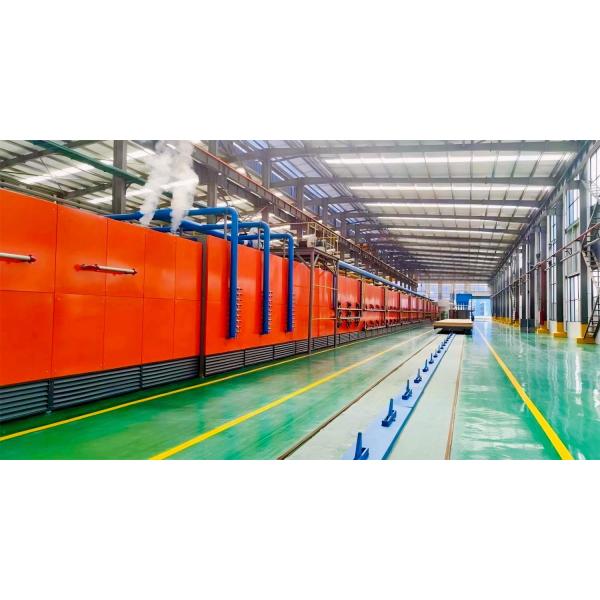
Features
1. High Efficiency & Stable Production
The tunnel kiln adopts a fully continuous production mode, enabling
24-hour uninterrupted operation. Bricks are pushed forward steadily
at a constant speed, passing through preheating, firing, and
cooling zones in sequence. This stable process ensures high output
and uniform product quality, avoiding defects such as deformation,
cracking, or uneven color caused by unstable temperature. The
automatic control system reduces manual operation and greatly
improves overall production efficiency.
2. Energy-Saving & Low Consumption
Equipped with high-performance insulation materials and optimized
flue gas circulation design, the kiln effectively reduces heat loss
and improves thermal efficiency. Waste heat from the cooling zone
can be recycled for preheating green bricks, significantly reducing
fuel consumption. Whether using natural gas, coal gas, or other
fuels, the energy utilization rate is much higher than that of
traditional kilns, helping enterprises save costs and meet
environmental protection requirements.
3. Precise Control & Long Service Life
The kiln is equipped with an intelligent temperature and pressure
control system, allowing real-time monitoring and adjustment of
firing parameters. The internal structure is made of high-quality
refractory materials that resist high temperature and corrosion,
ensuring stable performance under long-term working conditions. The
reasonable structural design reduces maintenance frequency and
extends the service life of the whole equipment, bringing long-term
benefits to users.

Applications
- Mainly used for firing red solid bricks, the most widely used wall material in cons truction projects.
- Suitable for producing hollow bricks and perforated bricks, which are lightweight, heat-insulating, and sound-insulating for
modern buildings.
- Applied to firing ceramic bricks, pavement bricks, and landscape bricks for municipal engineering, garden construction, and road paving.
- Used in large and medium-sized brick and tile manufacturing plants to realize automated and large-scale production.
- Suitable for building material industrial parks and new-type wall material
production bases that require high efficiency, energy saving, and environmental
protection.
- Can be customized and applied to various clay-based building
materials, meeting different regional standards and market demands.
FAQs
1. What fuels can this tunnel kiln use?
It can use natural gas, liquefied petroleum gas, coal gas, diesel,
and other conventional fuels. We can also customize the combustion
system according to local fuel conditions.
2. How much energy can be saved compared with traditional kilns?
Generally, it can save 20%–40% energy compared with traditional
intermittent kilns, depending on fuel type, insulation structure,
and operation management.
3. Is the operation difficult? Do you provide training?
The kiln adopts an intelligent control system, which is easy to
operate. We provide on-site installation, commissioning, and
professional operator training to ensure normal production.
4. What is the service life of the kiln?
With proper maintenance, the main structure and refractory part can
be used stably for more than 10 years, and vulnerable parts can be
replaced conveniently to extend the overall service life.

 Tunnel kiln high output modular firing sanitary ware toilet kiln

